


A location page is thin when removing the place name would leave something that could belong to any branch. Audit it with one test: cover the town name and read the page. If nothing remains that is true only of this location, the page is a template with a variable in it, and Google may index a few of them and ignore the rest. The fix is specifics, not word count: parking, the building, the people, the area served, the work done nearby.
Auditing location pages for thin content exists because nobody sets out to publish forty identical pages. It happens because a template was built for the first location and the rest were filled in by find and replace.
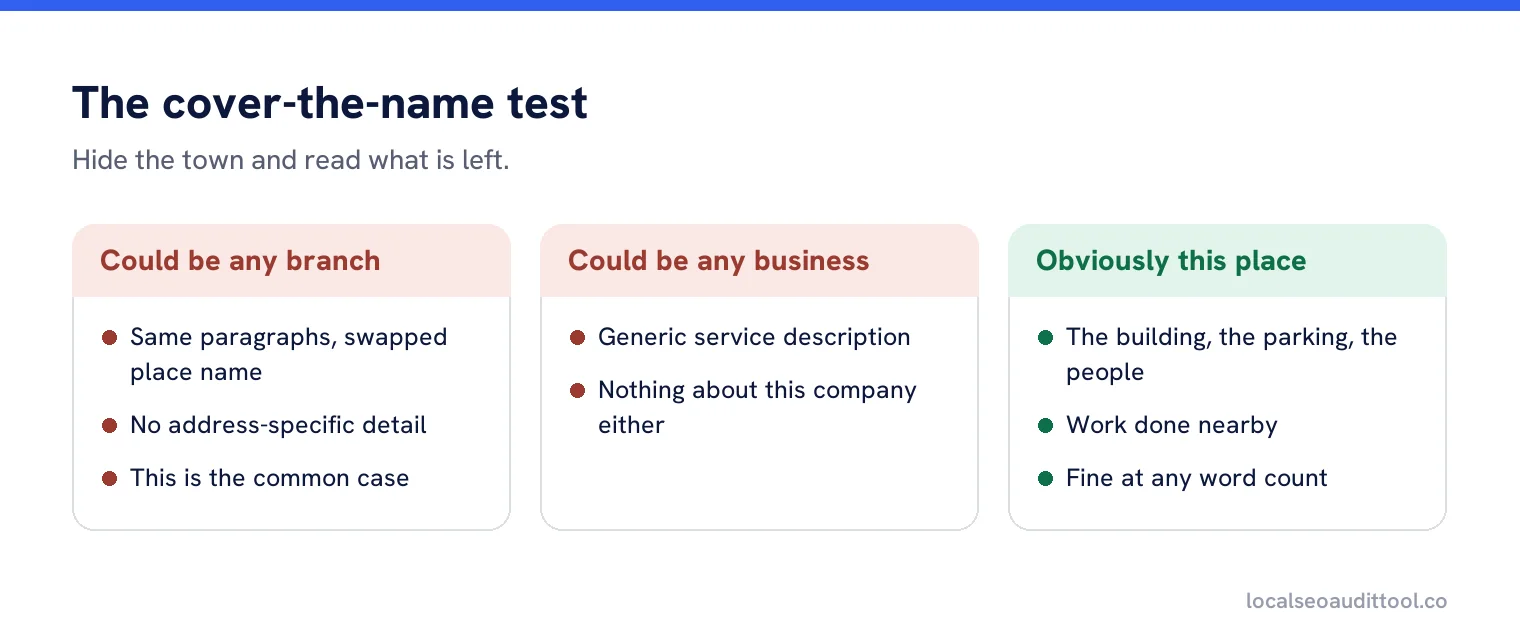
The cover-the-name test
Print the page, or paste it into a plain document, and hide every occurrence of the town. Read what is left. Three outcomes:
- It could be any branch. Thin. This is the common case.
- It could be any business of this type. Worse than thin, because it is also generic.
- It is obviously this place. Fine, whatever the word count.
What makes a page specific
The building
Where it is, what it looks like, which door, what is next to it. A sentence somebody local would write.
Getting there
Parking, the nearest station, the one-way system, the car park that charges after six.
The people
Who works there, named, with a photograph taken at that location.
What this branch does differently
Longer hours, a service only here, the van fleet based at this depot.
Proof from the area
Jobs done nearby, reviews from local customers, a case study from that town.
Notice that none of those require writing more. They require knowing something, which is why thin pages are usually a research problem rather than a writing problem.
What does not fix thin
| Common attempt | Why it fails |
|---|---|
| Spinning the paragraphs | Different words, same content. The cover-the-name test still fails. |
| Adding a town history paragraph | Irrelevant to the service and obvious filler. |
| Listing 40 nearby villages | Helps nobody and reads as an attempt to catch searches. |
| Embedding a bigger map | Adds no text and slows the page. |
| Raising the word count | Length is not the measure. Specificity is. |
Where the specifics come from
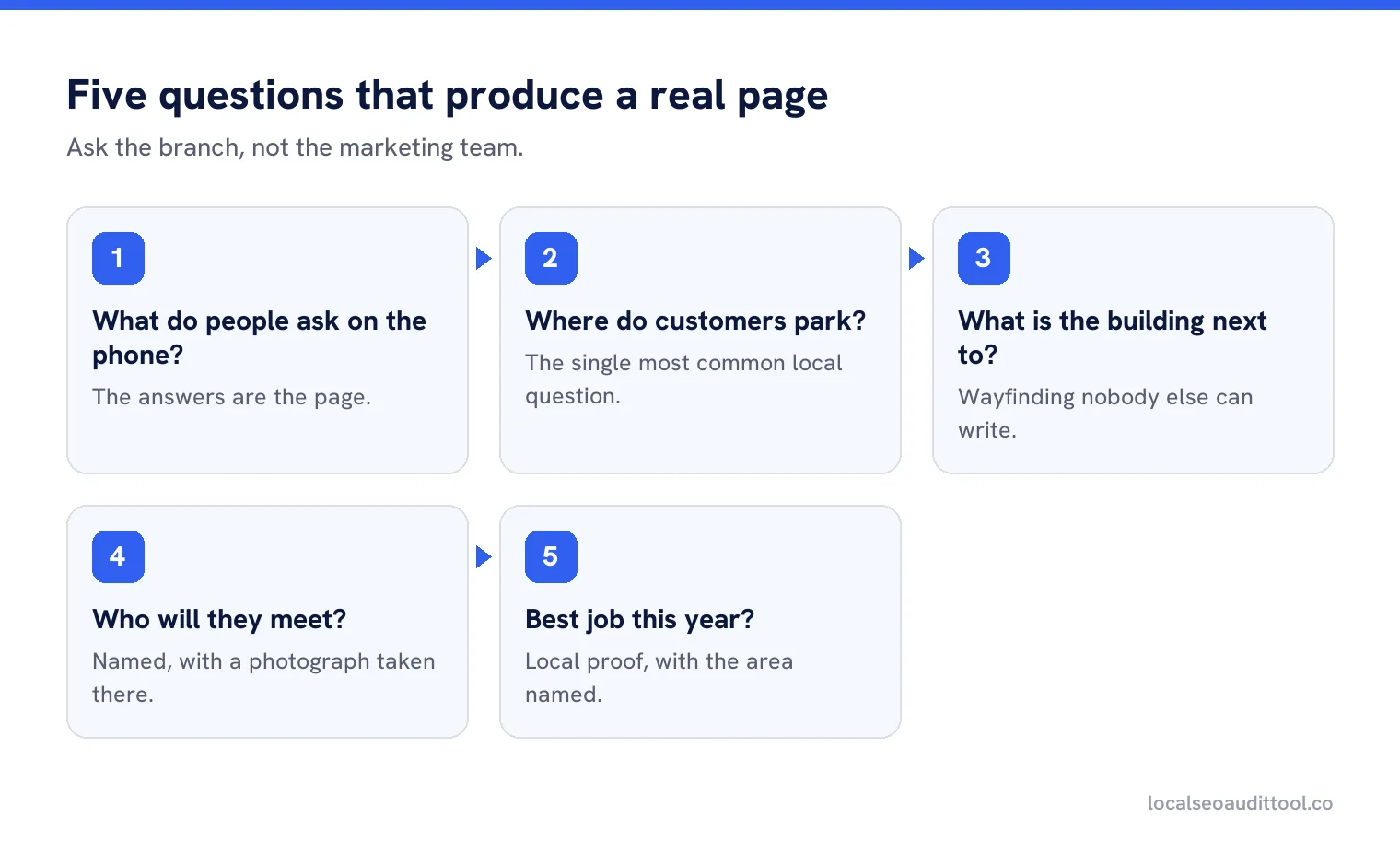
Ask the branch, not the marketing team. Five questions by email usually produce enough for a page: what do people ask when they phone, where do they park, what is the building next to, who will they meet, and what job are you proudest of this year.
For an estate of forty, that is forty short emails and perhaps half will reply. Half is enough to start, and the pages that get answers become the template for the rest.
Service area businesses
Trades without a visitable address face the same test with fewer props. The specifics come from the work instead of the building: a job completed in that area, the typical travel time, the local authority’s rules, the kind of housing stock and the problems it creates. A roofer writing about Victorian terraces in one town and 1960s flat roofs in another has two genuinely different pages.
What they should not do is publish a page for every village within thirty miles. That is the doorway page pattern, and it is both a quality problem and a maintenance burden nobody keeps up with.
A worked audit
An opticians group with 14 branches. Every page carried the same 300 words with the town swapped, plus an address block and a map. Search Console showed four of the fourteen indexed.
The audit finding was one line: these are one page published fourteen times. The work was five questions per branch, a photograph of each shopfront, and the name and a sentence about the optometrist who works there. Three branches turned out to have Saturday hours the website never mentioned, and two had parking arrangements that were the single most common phone question.
Pages went from 300 near-identical words to roughly 450 genuinely different ones. Within two months, 12 of 14 were indexed, and the two stragglers were branches that had never replied to the email.
Scoring a set of pages quickly
For an estate, you need a number rather than a reading of each page. Two measures get you most of the way. The first is similarity: compare the text of each page against every other, and anything above roughly 80 per cent identical goes on the list. The second is unique facts per page: count the statements that are true only of that location, using the five categories above. Zero is a problem, three or more is usually fine.
Both can be done crudely in a spreadsheet and neither needs a tool. The point is to produce a short list of the worst offenders rather than a precise score, because the work is the same either way: find out something true about the place and put it on the page.
How to prioritise
Do not rewrite all forty. Rewrite the three that matter most commercially, confirm they get indexed and attract traffic, then use them as the pattern. A proven template beats a mass rewrite nobody has tested.
What about AI-written pages
Generating forty location pages automatically produces fluent text and does not pass the cover-the-name test, because the generator knows nothing about the branch that the template did not already contain. Used the other way round it works well: collect the five answers from each branch first, then use a tool to turn those specifics into readable prose. The facts have to come from the business either way, and that is the part no generator can supply.
Keeping them from going thin again
Thin content returns quietly: the named optometrist leaves, the parking changes, the photograph ages. Add location pages to the same yearly rhythm as the profile audit, and ask the same five questions. It takes an afternoon and it is the only thing that keeps these pages worth indexing.
Find the pages that are copies
Compare your location pages against each other, see which are near-identical, and find the ones Google has skipped.
Frequently asked questions
What makes a location page thin?
If removing the town name leaves something that could belong to any branch, the page is a template with a variable in it rather than a page about a place.
Does a longer page fix thin content?
No. Length is not the measure. A 400 word page full of specifics beats a 1,200 word page that could describe any branch.
Why are only some of my location pages indexed?
Google may index a few near-identical pages and ignore the rest. That is a judgement about whether the pages add anything, not a penalty.
Where do I get local detail from?
Ask the branch. What people ask on the phone, where they park, what the building is next to, who they will meet, and the job they are proudest of.
Should I write a page for every nearby village?
No. That is the doorway page pattern. Write pages for areas the business genuinely serves, with something true of each.
Sources
The Google documentation behind the guidance on this page. Google changes these pages without notice, so check the date on any figure before you rely on it.