
A local SEO website audit is not a general SEO audit with a town bolted on. It checks five things in order: whether the pages that should exist do exist, whether Google can reach and index them, whether each one says plainly where the business operates, whether the business details on the site match the Business Profile, and whether a human can act within one screen. Everything else is ordinary SEO and can wait until those five are true.
Knowing how to audit a website for local SEO matters because most local businesses do not have a website problem that needs a hundred-point report. They have four pages that should exist and do not, and one page that contradicts their Google listing.
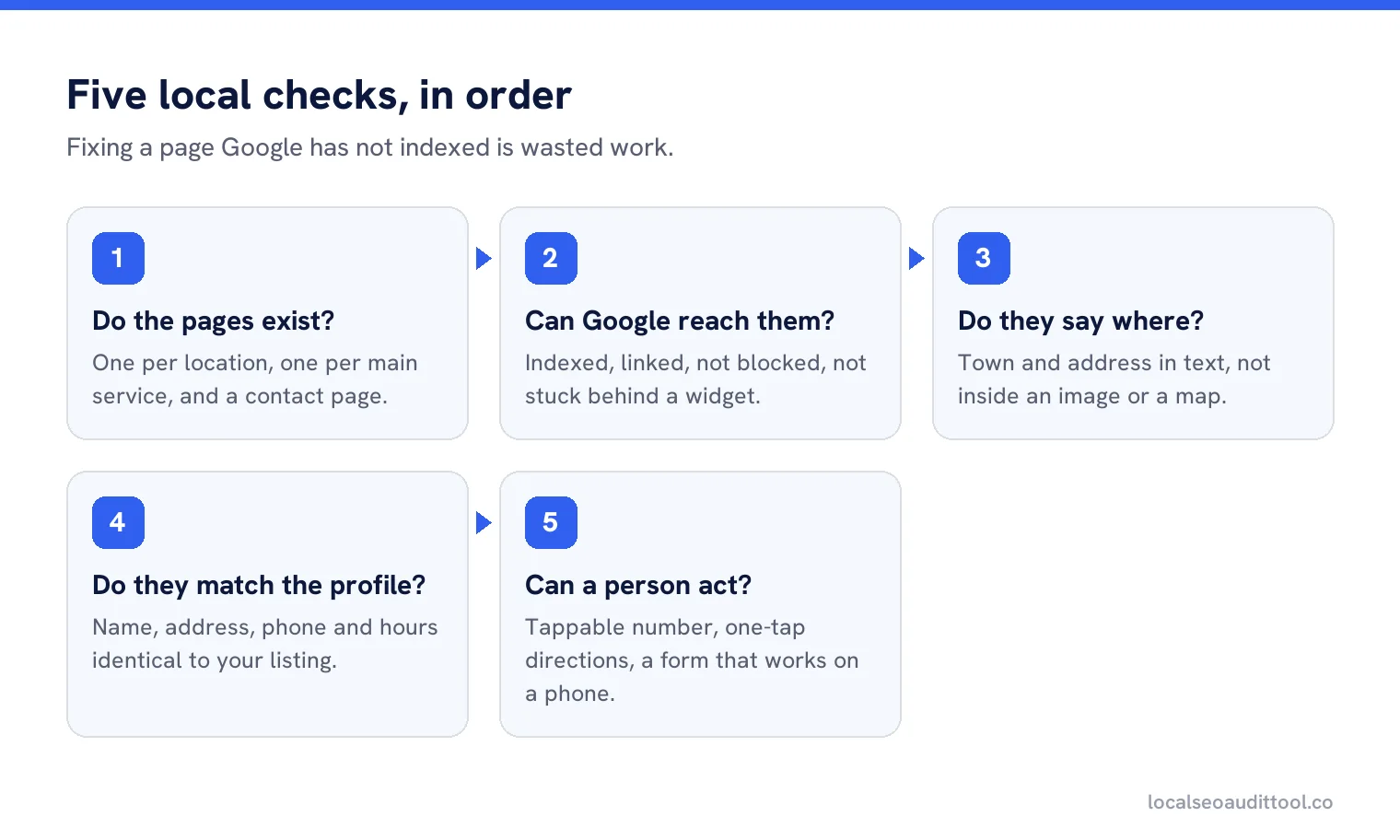
The five checks, in order
Do the right pages exist?
One page per location, one page per main service, and a contact page that answers where and when.
Can Google reach them?
Indexed, linked from somewhere, not blocked, not orphaned behind a map widget.
Do they say where?
Town, area, address where there is one, in text rather than in an image or a map embed.
Do they match the profile?
Name, address, phone and hours, identical to what Google already holds.
Can a person act?
Phone number tappable, address linked to directions, a form that works on a phone.
Why the order matters
Fixing title tags on a page Google has not indexed is wasted work. Improving a location page that does not exist is impossible. Teams routinely start at the technical end because that is where the tooling is, and finish the audit without ever asking whether the site has a page for the second branch.
Check one: the page inventory
List what should exist, then compare with what does. For a multi-location business the list is simple: a page per location, a page per service, and a page combining the two where the business genuinely serves that area for that service.
| Business | Pages that should exist |
|---|---|
| Single shop | Home, contact with address and hours, a page per main service or product range. |
| Three branches | A page per branch, plus service pages, plus a branch list page that links to all three. |
| Service area trade | A page per main service, and area pages only where the business genuinely works there. |
| Practice with practitioners | A page per practitioner, plus a page per treatment. |
Check two: can Google reach them?
Three questions answer this. Is the page in the sitemap? Is it linked from somewhere a crawler can follow? And does Search Console report it as indexed? Location pages fail most often on the second: they live inside a store finder widget that renders with JavaScript and links nowhere.
Google’s own guidance is that pages need to be discoverable through links, and anything a crawler cannot reach cannot rank. The fix is almost always a plain list of location links somewhere in the site, often the footer.
Check three: does it say where?
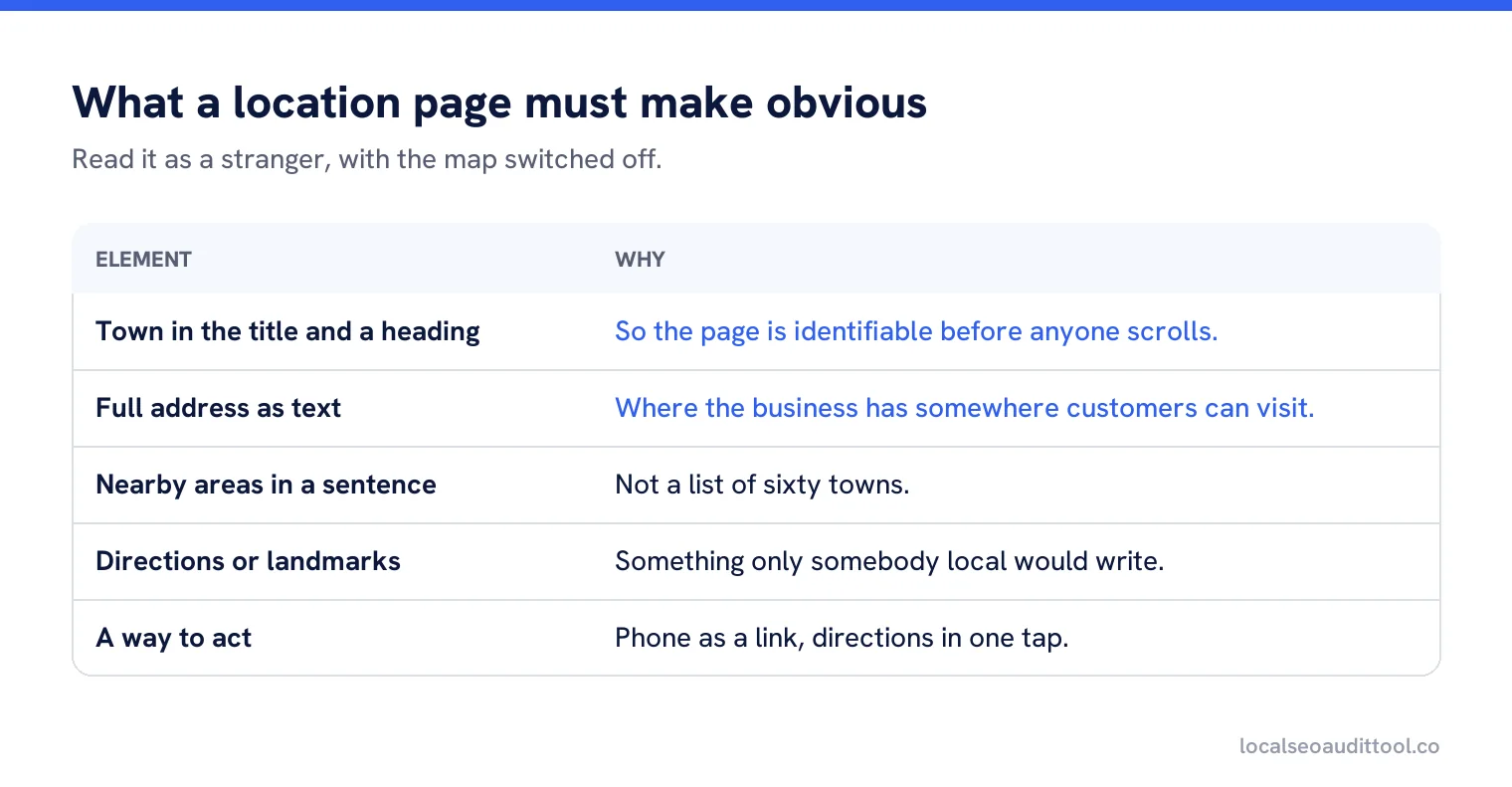
Open each location page and read it as a stranger. Is the town named in the heading, the body text and the title? Is the address in text rather than baked into an image? Is there any sentence that would tell somebody which area this page covers if the map failed to load?
- Town or area in the page title and in an on-page heading.
- Full address as text, where the business has a visitable address.
- Neighbouring areas named in a sentence, not in a list of 60 towns.
- Directions or landmarks that only somebody local would write.
Check four: does it match the profile?
Put the website and the Business Profile side by side. Google compiles profile information from several sources including publicly available content such as crawled web pages, so a contradiction between your site and your profile is not neutral. It is evidence that can support a suggested edit you did not want.
The four fields to compare are the name exactly as written, the address including the unit and the postcode format, the phone number, and the opening hours including any seasonal variation.
Check five: can a person act?
This is the check that produces the most immediate results and appears in the fewest audit templates. On a phone, from the top of the page: is the phone number a tappable link, does the address open directions in one tap, is the form short enough to complete standing up, and does anything require pinching to read?
What to leave out
A local audit does not need a backlink gap analysis, a crawl of 40,000 URLs, or a core vitals report in three colours. If the business has four pages and two of them are missing, none of those documents will change anything. Keep the audit to a page and spend the saved time doing the work.
A worked audit
A flooring company with three showrooms. The site has a home page, an About page, a gallery, and a contact page listing all three addresses in one block. No page per showroom, no page per service.
Check one fails immediately: eight pages should exist and four do. Check two is moot for pages that do not exist, although the gallery turns out to be indexed and the contact page is not, because it is linked only from a hamburger menu built in JavaScript.
Check three fails everywhere: the word “Leeds” appears twice on the entire site, both times in an image. Check four finds the phone number on the site is an old tracking number that no longer matches any profile. Check five finds the phone number is not a link and the addresses do not open directions.
The resulting plan has six items, of which three are new pages. Nothing in it mentions schema, speed or backlinks, and all three of those would have appeared in a generic audit while the missing showroom pages went unnoticed.
Recording it
One row per finding: the page, what is wrong, the evidence, and which of the five checks it belongs to. Sorting by check number gives you the order of work for free, which is the main thing a client wants and rarely gets.
How often
Twice a year for a stable site. Immediately after a redesign, a migration, a rebrand or a new location, because those are the four events that break local pages, usually silently, and usually in the same way: the location pages move and nothing points at them any more.
Audit the site and the profile together
Check location pages, business details and profile data in one pass, and see exactly where the two disagree.
Frequently asked questions
What is different about a local SEO website audit?
It starts with whether the right pages exist at all, and whether the site agrees with the Business Profile, rather than with technical scores.
How many pages should a local site have?
One per location, one per main service, and combinations only where the business genuinely offers that service in that area. Contact details on every one.
Why are my location pages not indexed?
Most often because they sit inside a store finder widget that renders with JavaScript and links nowhere. Add plain links a crawler can follow.
Does my website affect my Google Business Profile?
Yes. Google compiles profiles partly from crawled web content, so a site that contradicts your profile can support a suggested edit you did not want.
How often should I run this audit?
Twice a year, and immediately after a redesign, migration, rebrand or new location, which are the four events that silently break local pages.
Sources
The Google documentation behind the guidance on this page. Google changes these pages without notice, so check the date on any figure before you rely on it.